7 min read • 1,544 words
Python vs C++: Which Language Should You Learn?
Choosing the right programming language to learn can significantly impact your development journey. In the debate of Python vs C++, each language offers unique advantages and challenges. Python is often recommended for beginners due to its straightforward syntax and readability, allowing newcomers to grasp programming concepts without getting bogged down by complex rules. Its extensive standard library and supportive community facilitate rapid application development, making it a popular choice for web development, data analysis, and automation.
On the other hand, C++ provides developers with greater control over system resources and memory management, which is essential in performance-critical applications such as game development and system software. Understanding the differences between these two languages will help you make an informed decision based on your goals, whether you aim for quick prototyping or require deep system-level programming. This article will explore the strengths and weaknesses of both languages to guide your learning path.
Introduction to Python and C++
Python and C++ are two of the most widely used programming languages in the world today, each with its unique strengths and applications. Python, created by Guido van Rossum and first released in 1991, emphasizes readability and simplicity, making it an excellent choice for beginners. C++, developed by Bjarne Stroustrup and introduced in 1985, is an extension of the C programming language and is known for its performance and efficiency, particularly in system-level programming.
The historical context of both languages reveals their evolution over the years. Python has grown from a scripting language to a powerful tool for web development, data analysis, artificial intelligence, and more. Its extensive libraries and frameworks, such as Django and Pandas, have made it a favorite among developers. On the other hand, C++ has maintained its relevance in high-performance applications, such as game development, real-time systems, and applications requiring direct hardware manipulation.
Key features of Python include:
- Dynamic typing and automatic memory management
- A vast standard library and community-contributed modules
- Support for multiple programming paradigms, including procedural, object-oriented, and functional programming
In contrast, C++ offers:
- Static typing and manual memory management
- Object-oriented features, including inheritance and polymorphism
- Low-level manipulation capabilities, allowing for fine-tuned performance
Common use cases for Python include web applications, data science, and automation scripts, while C++ is often used in game development, embedded systems, and performance-critical applications. Understanding the differences between these languages can help you decide which one to learn based on your goals and interests in the realm of programming.
Syntax and Ease of Learning
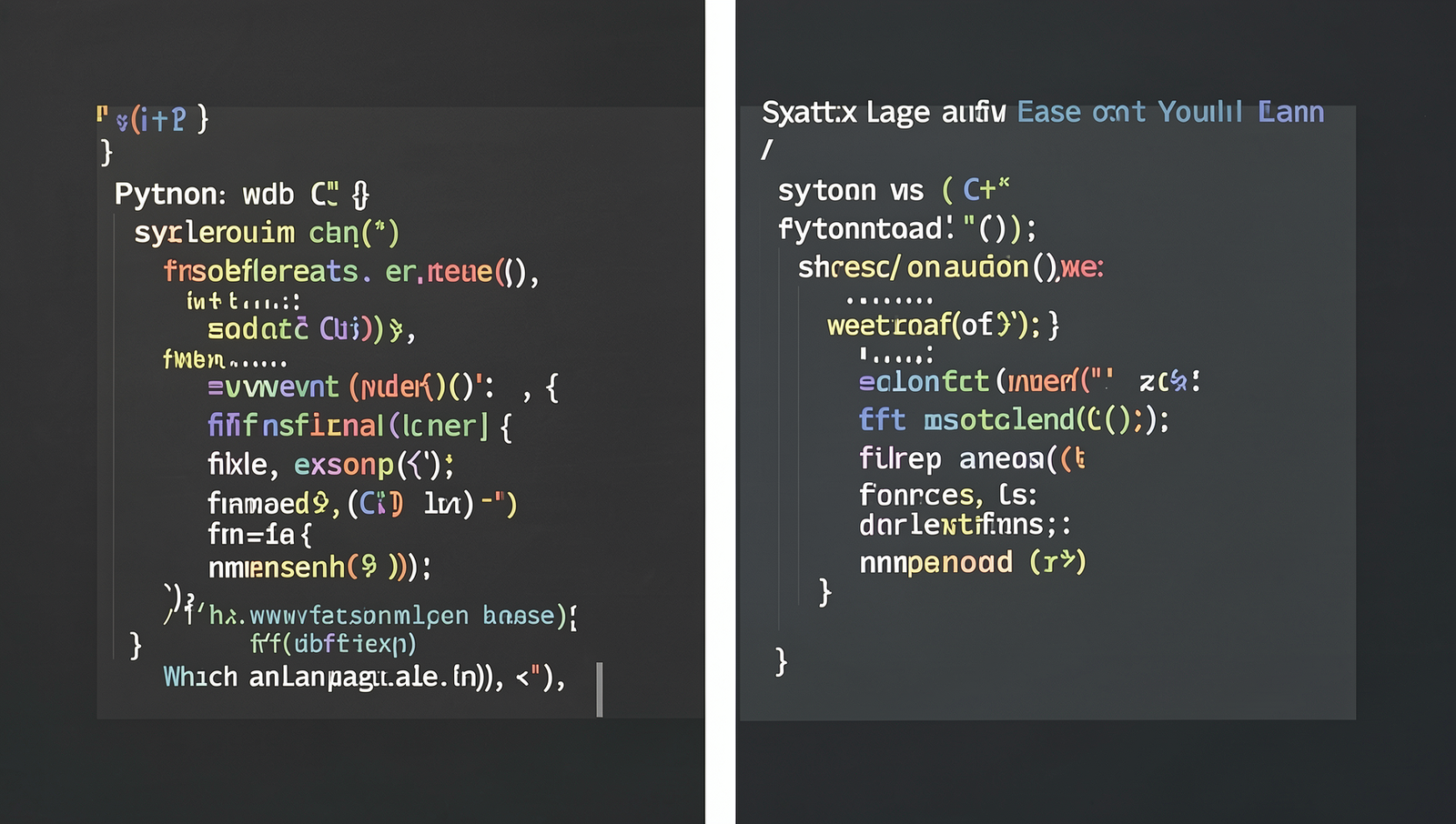
When comparing Python vs C++, one of the most significant factors to consider is the syntax and ease of learning. Python is renowned for its simplicity and readability, making it an excellent choice for beginners. Its syntax is designed to be intuitive, allowing new programmers to grasp concepts quickly without getting bogged down by complex rules.
One of the standout features of Python is its use of indentation to define code blocks. This indentation-based structure not only enhances readability but also enforces a clean and organized coding style. For example, a simple conditional statement in Python looks like this:
if x > 10:
    print("x is greater than 10")
In contrast, C++ has a more complex syntax that can be daunting for newcomers. The use of semicolons to terminate statements and curly braces to define code blocks adds to the learning curve. A similar conditional statement in C++ would be written as follows:
if (x > 10) {
    std::cout << "x is greater than 10";
}
This complexity can make it challenging for beginners to focus on learning programming concepts rather than getting lost in syntax details. Additionally, C++ requires a deeper understanding of concepts like memory management and pointers, which can further complicate the learning process.
- Python: Simple, readable syntax, indentation-based structure.
- C++: Complex syntax, requires understanding of additional concepts.
Ultimately, for those new to programming, Python's straightforward syntax offers a more accessible entry point, while C++ may be better suited for those looking to delve into more advanced programming topics.
Performance and Efficiency
When comparing Python vs C++, one of the most significant factors to consider is performance and efficiency. C++ is a compiled language, which means that the code is translated directly into machine code before execution. This results in faster execution speeds, making C++ ideal for performance-critical applications such as game development, real-time systems, and high-frequency trading platforms. In contrast, Python is an interpreted language, which means that code is executed line by line. This can lead to slower execution times, particularly in scenarios where speed is paramount.
Memory management is another crucial difference between these two languages. C++ gives developers direct control over memory allocation and deallocation through pointers and manual memory management techniques. While this allows for optimized memory usage, it also increases the risk of memory leaks and errors. Python, on the other hand, employs automatic memory management through garbage collection, which simplifies development but can introduce overhead and unpredictability in performance.
- Execution Speed: C++ generally outperforms Python in execution speed due to its compiled nature.
- Memory Management: C++ requires manual management, while Python uses garbage collection.
- Compiled vs Interpreted: C++ is compiled, leading to faster runtime, whereas Python is interpreted.
In scenarios where performance is critical, such as in embedded systems or large-scale applications, the choice between Python vs C++ can significantly impact the overall efficiency and responsiveness of the software. Developers must weigh the benefits of rapid development in Python against the performance advantages of C++. Ultimately, the choice of language should align with the specific needs and constraints of the project at hand.
Community and Ecosystem
When considering Python vs C++, one of the most significant factors to evaluate is the community and ecosystem surrounding each language. Both languages have strong communities, but they cater to different needs and preferences.
Python boasts a large and active community, which is particularly beneficial for beginners. The language's simplicity and readability attract many new programmers, leading to an abundance of tutorials, forums, and online resources. Popular platforms like Stack Overflow and GitHub are filled with Python projects, making it easier for developers to find help and collaborate. In contrast, C++ has a more specialized community, often focused on performance-critical applications such as game development and systems programming.
In terms of libraries and frameworks, Python excels with its extensive collection of libraries for data science, web development, and machine learning. Some notable libraries include:
Pandasfor data manipulationFlaskandDjangofor web developmentTensorFlowandPyTorchfor machine learning
C++, while having fewer libraries, is known for its powerful frameworks like Qt for GUI applications and Boost for general-purpose programming.
Regarding job market demand, Python developers are in high demand, especially in fields like data analysis and artificial intelligence. C++ developers, while fewer in number, are sought after for roles in game development and systems-level programming. Both languages offer ample resources for learning, including online courses, books, and community-driven platforms.
Conclusion
In the debate of Python vs C++, both languages offer unique advantages that cater to different programming needs. Python is renowned for its simplicity and readability, making it an ideal choice for beginners and those looking to develop applications quickly. Its extensive libraries and frameworks support a wide range of applications, from web development to data analysis and artificial intelligence. On the other hand, C++ provides powerful performance and control over system resources, making it suitable for high-performance applications, game development, and systems programming. Understanding the strengths of each language can help you make an informed decision based on your career goals and project requirements.
When deciding between Python vs C++, consider your personal interests and the specific fields you wish to enter. If you're drawn to data science, machine learning, or web development, Python may be the better choice. Conversely, if you aspire to work in game development or systems-level programming, C++ could be more beneficial. Ultimately, both languages are valuable, and learning either will enhance your programming skills and open up numerous opportunities in the tech industry.
Frequently Asked Questions
What are the main differences between Python and C++?
The main differences between Python and C++ lie in their syntax and usage. Python is known for its simplicity and readability, making it easier for beginners. In contrast, C++ offers more control over system resources and memory management, which can lead to more complex code.
Which language is better for beginners?
Python is generally considered better for beginners due to its straightforward syntax and extensive libraries. It allows new programmers to focus on learning programming concepts without getting bogged down by complex syntax rules, making it an ideal starting point.
Is C++ faster than Python?
Yes, C++ is typically faster than Python because it is a compiled language, while Python is interpreted. C++ allows for more efficient memory management and lower-level programming, which can lead to better performance in resource-intensive applications.
What are common use cases for each language?
Python is commonly used in web development, data analysis, artificial intelligence, and automation due to its simplicity and